

 Book Editing
 Author Website
 Audio Book
 Book Video
 Book Cover Design
 Illustration
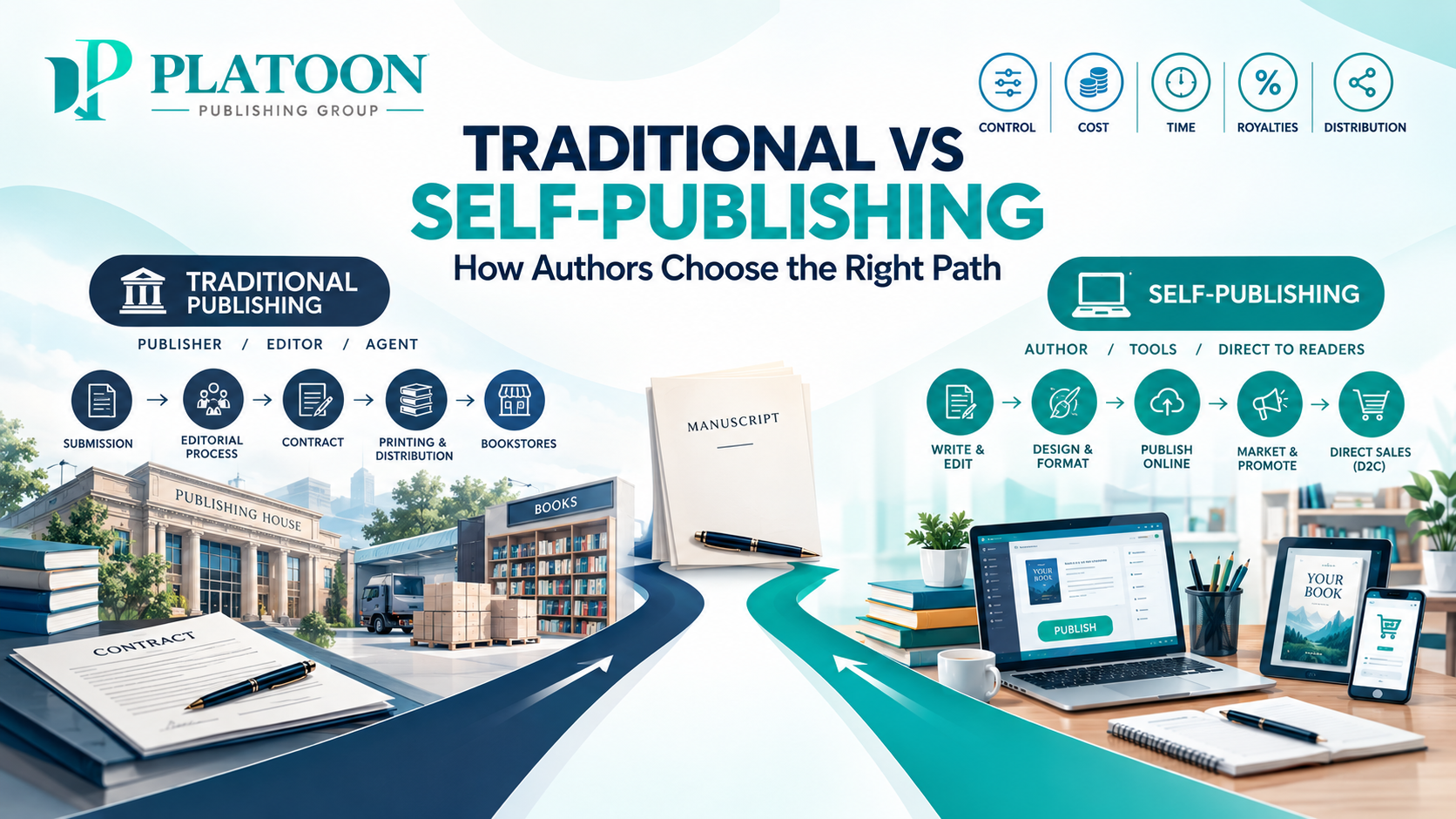
Once a manuscript is finished, another important question begins: how should the book actually be published?
For some authors, the answer is to pursue a traditional publishing deal. For others, self-publishing offers a more direct route from completed manuscript to published book. Both approaches can turn a manuscript into a finished book, but the experience of getting there can be very different.
Traditional publishing and self-publishing place responsibility in different hands. A traditional publisher typically manages much of the production and distribution process, while a self-publishing author takes responsibility for coordinating those areas independently or hiring professionals to help.
Understanding those differences can make the decision easier.
What happens when you choose traditional publishing?
Traditional publishing usually begins before the book ever reaches a printing or distribution stage.
Depending on the publisher and genre, an author may first approach literary agents with a query letter, synopsis, sample chapters, or a complete manuscript. If an agent agrees to represent the author, the agent may submit the project to publishing houses.
If a publisher decides to acquire the book, the author and publisher enter into a publishing agreement. That contract determines important matters such as rights, royalties, advances, publication obligations, and other terms.
From there, the publisher generally coordinates the major production stages.
The manuscript may go through editorial development, copyediting, and proofreading. The publishing team may oversee the cover, interior design, printing, distribution, sales, and other production requirements.
For the author, this means fewer individual production decisions to manage.
It also means that the author does not usually have complete control over every decision.
What happens when you self-publish?
Self-publishing changes the starting point.
Instead of waiting for a publisher to acquire the manuscript, the author decides when the book is ready to enter the market.
The author can work with independent professionals for the different stages of production. An editor can prepare the manuscript, a cover designer can create the cover, and a formatter can prepare the interior for print and ebook editions.
The author can then publish through platforms and distribution services such as Amazon Kindle Direct Publishing and other self-publishing providers.
This model gives authors considerable flexibility.
However, flexibility comes with responsibility. The author becomes responsible for making decisions that a traditional publisher would normally handle.
That can include production, pricing, metadata, distribution, marketing, advertising, and publication scheduling.
Who pays for the book?
Money is one of the first things authors consider when comparing traditional publishing vs self-publishing.
In traditional publishing, the publisher generally finances the standard production of an acquired book. Depending on the agreement, this can include editorial work, cover production, typesetting, printing, distribution, and related publishing expenses.
Many traditional publishing agreements also include an advance against royalties. An advance is paid to the author before royalties from book sales have fully recouped the advance. The specific amount and payment structure vary from contract to contract.
Self-publishing works differently.
The author normally pays for the professional services they choose to use. That might mean paying for editing, proofreading, cover design, formatting, illustrations, marketing, advertising, or other services.
However, self-publishing does not necessarily mean purchasing thousands of printed books.
Print-on-demand services can produce individual copies when readers place orders. Amazon KDP, for example, offers print-on-demand publishing for eligible paperback and hardcover books.
This allows authors to avoid the need for a large upfront print inventory in many cases.
What about royalties?
Royalty percentages can make self-publishing appear straightforward at first glance, but there is more to consider.
Traditional publishing contracts establish the author's royalty rate and the way royalties are calculated. The rate can vary depending on the publisher, format, sales channel, contract, and other factors.
Authors may also have an agent, whose commission needs to be considered when calculating their earnings.
Self-publishing platforms often advertise higher royalty percentages because the author is taking on more of the publishing responsibility.
Amazon KDP, for example, currently offers 35% and 70% royalty options for eligible ebooks. The 70% option has specific eligibility requirements and deductions.
For print books, KDP offers different royalty structures depending on the marketplace, list price, distribution method, and book format. Printing costs can also be deducted from the author's royalty.
That means a higher royalty percentage does not automatically equal higher profit.
A more useful calculation is the actual amount the author receives per sale after applicable platform, printing, delivery, distribution, and production costs.
How much control does the author have?
This is where the two publishing models can feel very different.
A traditional publisher invests in the book and takes responsibility for bringing it to market. As part of that arrangement, the publisher generally has a significant say in areas such as editing, cover design, positioning, production, and publication strategy.
The exact level of author involvement varies.
Some authors may work closely with their editorial and design teams, while others may have less influence over certain decisions.
Self-publishing puts those decisions much more directly in the author's hands.
The author can select the cover design, approve the final formatting, decide when to publish, establish the pricing strategy, choose distribution channels, and determine how the book is positioned.
That freedom can be particularly important for authors who already have a clear vision for their book.
But control also means accountability.
If the cover does not appeal to the intended audience, the author must address it. If the metadata is poorly prepared, the author must correct it. If marketing is not generating results, the author must reconsider the strategy.
Which option is faster?
Publishing timelines are another major difference.
Traditional publishing generally follows a longer schedule because several stages have to happen before publication. The process can include finding an agent, securing a publisher, completing the contract, editorial development, production, scheduling, printing, and distribution.
Even after a publisher accepts a manuscript, publication may still be some time away.
Self-publishing can be much faster.
Once the manuscript has been edited, designed, formatted, and prepared according to the selected platform's requirements, the author can move toward publication without waiting for a publisher's acquisition and production schedule.
Fast publication, however, should not be confused with rushed publication.
A book can technically be uploaded quickly, but professional editing, proofreading, design, formatting, and quality control still require adequate time.
Which method gives a book wider distribution?
Distribution is more complicated than simply asking whether a book is available online.
Traditional publishers generally have established relationships with distributors, retailers, bookstores, and other parts of the publishing industry. These relationships can make it easier for traditionally published books to enter established trade channels.
Self-published books can also be distributed through online retailers and certain distribution networks.
For example, eligible KDP paperbacks can use Expanded Distribution to make books available to distributors that serve bookstores and libraries.
But availability through a distributor does not guarantee that a bookstore will physically stock the book.
Getting a book onto a physical shelf can involve factors such as retailer demand, sales history, distribution arrangements, local relationships, author events, publicity, and the individual bookstore's purchasing decisions.
For an author whose primary goal is broad physical bookstore presence, distribution should therefore be considered separately from simple online availability.
Who handles marketing?
Marketing is often misunderstood in both publishing models.
Choosing a traditional publisher does not necessarily mean the author can stop thinking about marketing. Publishers may provide marketing and publicity support, but the amount of support varies depending on the publisher, book, market, and publishing strategy.
Authors can still be expected to participate in building awareness for their work.
In self-publishing, the author generally has to take an even more active role.
Marketing may involve:
- Search engine optimization
- Amazon advertising
- Social media
- Email marketing
- Digital PR
- Book reviews
- Podcast appearances
- Author interviews
- Promotional campaigns
- Speaking opportunities
- Reader communities
- Website content
An author can manage these activities personally or hire specialists.
The important difference is who is responsible for coordinating the strategy.
What are the advantages of traditional publishing?
Traditional publishing can be attractive to authors who want an established publishing organization behind the book.
Potential advantages include professional editorial support, publisher-funded production, established distribution networks, an advance under many contracts, and access to industry professionals.
The author also does not have to independently coordinate every production stage.
At the same time, the process can be competitive and lengthy. Authors may need to secure representation and convince a publisher that the project fits its list and commercial strategy.
There can also be less control over certain aspects of the final book.
What are the advantages of self-publishing?
Self-publishing offers a different set of possibilities.
An author can maintain greater control over the project, choose the professionals they want to work with, determine the publication schedule, and make decisions about pricing and distribution.
It can also provide a faster route to market.
For authors who have a strong understanding of their audience or already have an established platform, the ability to control the publishing and marketing strategy can be particularly useful.
The trade-off is that the author has to finance and coordinate more of the process.
What are the disadvantages of traditional publishing?
The traditional route can require patience.
An author may spend considerable time querying agents before receiving representation, and an agent may then need to submit the project to multiple publishers.
Even after acquisition, the publishing process can take months or longer.
Creative control is another consideration. The publisher may have contractual authority over certain decisions, so authors should understand the terms of a publishing agreement before signing.
Financial arrangements also vary. An advance can provide income before royalties are earned, but royalties generally do not begin paying out until the applicable advance has been recouped under the contract.
What are the disadvantages of self-publishing?
The biggest difference is responsibility.
The author has to make decisions that a publishing company would normally make.
A professional book may require several different specialists, including an editor, proofreader, cover designer, formatter, illustrator, marketer, or publicist.
The author also needs to understand publishing platforms, metadata, pricing, distribution, copyright and rights management, and marketing.
The ability to publish quickly can therefore be both an advantage and a challenge. Without appropriate quality control, speed can result in a book reaching readers before it is properly prepared.
Is self-publishing only for certain types of books?
No.
Self-publishing is used for many types of books, including fiction, nonfiction, memoirs, business books, children's books, poetry, educational titles, and niche-interest publications.
However, the most suitable publishing strategy can differ significantly by genre.
A children's picture book, for example, may have very different production requirements from a business book or a novel because illustration, page design, printing specifications, and audience expectations can all affect the publishing process.
That is why authors should consider the specific requirements of their book rather than choosing a publishing method based solely on royalty percentages.
Can a self-published book later become traditionally published?
It can happen, but self-publishing does not automatically lead to a traditional publishing contract.
A self-published book may attract attention because of its readership, sales performance, concept, or author platform. A traditional publisher would still need to evaluate the project and determine whether acquiring it fits its publishing strategy.
Authors considering this route should also pay close attention to rights. Publishing agreements, platform terms, and existing editions can affect what rights remain available for a later publishing arrangement.
So, which publishing route makes sense?
There is no single publishing model that fits every author.
Think about what matters most to you before making the decision.
If you want an established publisher to take on much of the production and distribution responsibility, traditional publishing may be worth exploring.
If you want to control the creative process, publication schedule, pricing, and publishing strategy, self-publishing provides considerably more direct control.
Budget matters as well.
Traditional publishing generally means the publisher finances standard production, while self-publishing means the author decides which services to purchase and pays for them.
Time matters.
Traditional publishing can involve a longer journey from manuscript to publication. Self-publishing can move faster once the book is properly prepared.
Distribution matters.
Traditional publishers can provide established trade distribution, while self-publishing provides strong access to online marketplaces and can also use distribution services for additional channels.
And finally, expectations matter.
Publishing a book is not simply a choice between two buttons. It is a business and creative decision involving production quality, rights, distribution, marketing, finances, and the author's long-term goals.
Traditional Publishing or Self-Publishing: Start With Your Goals
The most useful way to approach the decision is to begin with the result you want.
Do you want a publishing partner?
Do you want maximum control?
Do you have a budget for professional services?
Do you want to publish as quickly as possible?
Is physical bookstore distribution a major objective?
Are you comfortable managing marketing and publishing decisions?
Your answers can help clarify which model deserves further investigation.
Traditional publishing and self-publishing are not simply competing ways to print a book. They represent two different approaches to managing the publishing process.
Understanding the responsibilities, costs, timelines, rights, distribution options, and financial structures of each approach gives authors a much clearer foundation for deciding how they want to bring their books to readers.